
Radiant Flux
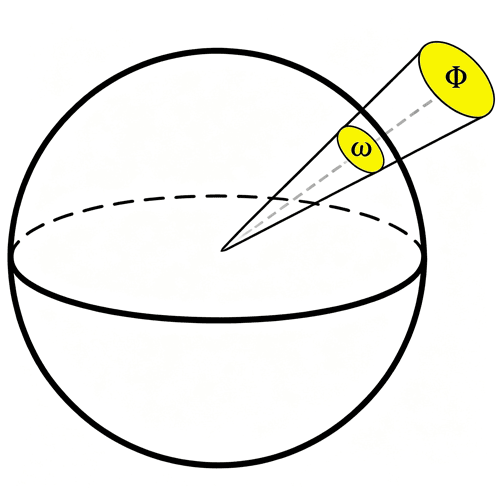
单位时间光源所辐射(向所有方向)的能量
$$ \Phi = \frac{\mathrm{d}Q}{dt} $$Intensity
光源沿某个方向辐射出的单位时间能量(Radiant Flux)
$$ I = \frac{\mathrm{d}\Phi}{\mathrm{d}\omega} $$其中,$\omega$ 为立体角 由于立体角全角为 $4\pi$,则一般地
$$I = \frac{\Phi}{4\pi}$$
Irradiance
光源向 单位面积(垂直) 所辐射的单位时间能量(Radiant Flux)
$$ E = \frac{\mathrm{d}\Phi}{\mathrm{d}A_\perp} = \frac{\mathrm{d}\Phi}{\mathrm{d}A \cos\theta} $$其中,$\theta$ 为光线与面法线的夹角
也就是说单位面积接收了四面八方来的光辐射
$I$ 和 $E$
$I$ 指的是光源的发射 $E$ 指的是光源的接收
Radiance
单位时间、沿某个方向 、向单位面积(垂直) 所辐射的能量
$$ L = \frac{\mathrm{d}^2\Phi}{\mathrm{d}A_\perp \mathrm{d}\omega} = \frac{\mathrm{d}^2\Phi}{\mathrm{d}A \cos\theta \mathrm{d}\omega} $$
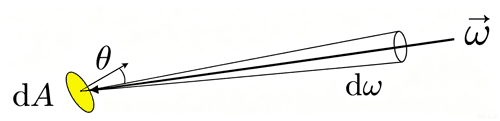
也就是说单位面积只接收了来自特定方向的光辐射
Radiance → Irradiance
$$ E(p) = \int_{H^2} L_i(p,\vec{\omega})\cos\theta \mathrm{d}\omega $$- $p$: $p$ 点(定点)
- $\vec{\omega}$:光方向(积分变量)
- $\theta$:光与法线夹角(积分变量)
- $H^2$:以点 $p$ 的法线为中心的半球,表示所有可能的入射方向
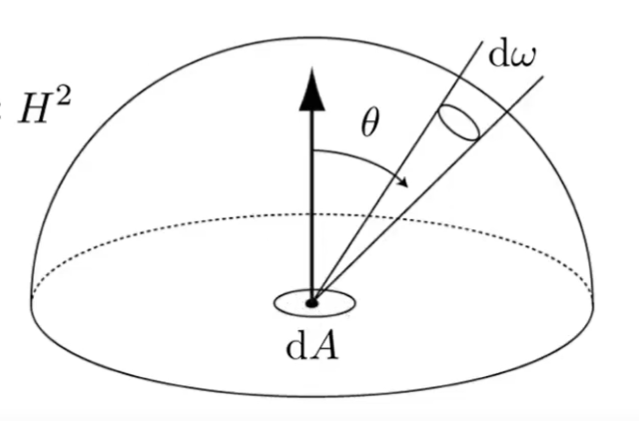
实际上就是在计算:给定 Radiance 算出 p 点能接收到的所有方向的光辐射的和(单位时间)
BRDF
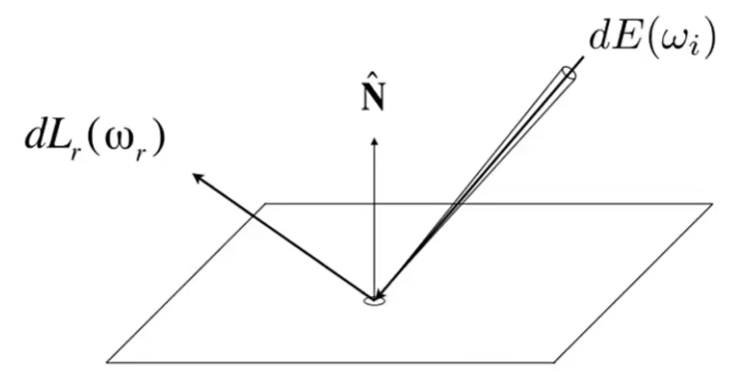
这些吸收到的能量又从这个区域被辐射出去,向 $\omega_r$ 方向辐射的能量为:
BRDF为“从某个角度辐射的能量”与“来自某个入射角度并向所有角度辐射的总能量”的比例,由此可得到该比例为:
$$ f_r(w_i\rightarrow w_r) = \frac{\mathrm{d}L_r(w_r)}{\mathrm{d}E_i(w_i)} = \frac{\mathrm{d}L_r(w_r)}{L_i(w_r)\cos\theta_idw_i} $$那么我们便可以反过来,计算出向 $\omega_r$ 方向辐射的能量:
$$ L_r(w_r) = \int_{H^2}f_r(w_i\rightarrow w_r)L_i(w_i)\cos\theta_idw_i $$